UAE Transitions 50% of Gov’t Services to Agentic AI
The United Arab Emirates says it’s creating a foundation of security and safety as it transforms its public service footprint.

The United Arab Emirates says it’s creating a foundation of security and safety as it transforms its public service footprint.
The United Arab Emirates (UAE) plans to move half of its government operations, services, and sectors to autonomous AI agents over the next two years, prompting a conversation around how it intends to secure and monitor those AI agents.
To that end, the UAE has implemented a “control tower agent,” conducts audits using agents and humans, and considers monitoring and establishing trust as critical to its efforts, Omar Sultan Al Olama, minister of state for artificial intelligence, told attendees on Oct. 14 at the World Economic Forum’s (WEF) Annual Meeting of Global Future Leaders in Dubai. Security and trust are critical to achieving the nation’s goal of autonomous government systems that improve quality of life and to not risk harm to citizens, he said.
“There is an oversight that ensures that we understand what agents are doing, how they’re taking certain actions — there’s a continuous audit that is being done,” Al Olama told attendees. “There’s an audit that’s done by agents, and there’s an audit that’s done by humans to ensure that this doesn’t go haywire in any way, shape, or form.”
In April, the UAE Cabinet unveiled a framework to transition 50% of the federal government’s sectors, services, and operations to agentic AI within two years. The effort aims to redesign government policies and processes to embrace AI capabilities, creating “smart systems” that take proactive actions to reduce operational costs, provide more efficient services to citizens, and make government more efficient, according to public notes from the meeting.
The UAE’s plans for agentic AI should not be surprising. While global AI diffusion — a measure of the number of adults who used a generative AI product in a specific period — hit 19% in the second quarter of 2026, the United Arab Emirates has taken the lead globally with more than 73% of the population using AI during the quarter, according to Microsoft’s “Global AI Diffusion: Q2 2026 Trends and Insights” report.
Yet at the same time, the risk landscape is changing, often because of AI use. The UAE has already faced significant increases in attacks over the past two years, many powered by AI agents, as political tensions and military conflicts continue to build in the region.
UAE Says It’s Focused on Secure & Safe AI Deployments
The government’s Agentic AI Project will roll out in several phases across ministries and federal entities, it said. On Oct. 9, the Ministerial Council for Artificial Intelligence and Development reviewed the first phase of the project, focused on “building government capabilities, surveying and assessing government services, operations and tasks, and setting priorities,” according to a statement announcing the review. The second phase will establish a national technical ecosystem for agentic AI, under the name “FedAI,” that will enable government agencies to develop and operate agentic services and conduct internal competitions, such as hackathons, to develop applications.
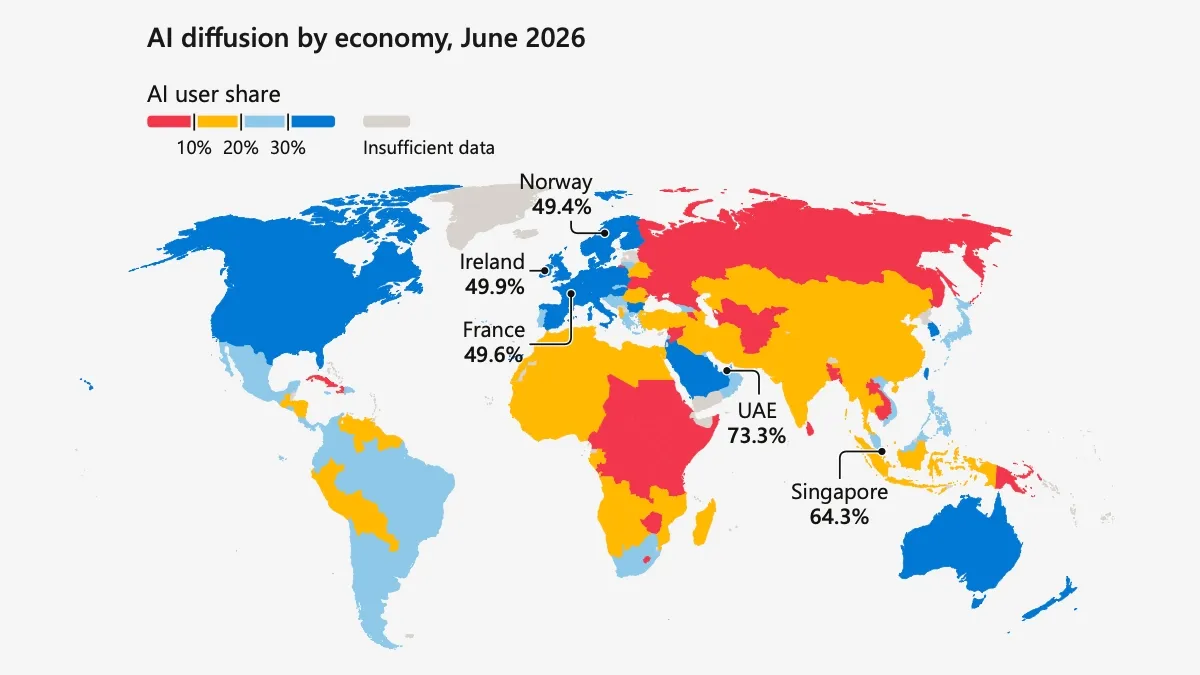
The UAE leads other nations with 73% of its population using generative AI at least once in the quarter. Source: Microsoft
The coming phase includes training for government employees in agentic AI development and generative AI technology to provide a foundation for the future, Sheikh Mansour bin Zayed Al Nahya, one of the UAE’s two vice presidents and deputy prime minister, said in the statement.
“We are building a government system that is smarter, more flexible, and more proactive; a system that leverages agentic AI to develop services, operations, and tasks, and to shape policies and decisions,” he said. “This should be achieved in a secure and reliable digital infrastructure, in a way that strengthens the readiness of the UAE Government for the future and reinforces its leadership in developing government work models.”
Security and trust are critical for operations conducted by agentic AI systems, and that means monitoring and auditing agentic activity, says Evin McMullen, co-founder and CEO of AmanTrue, a Dubai-based startup creating a governance control layer for agentic AI.
“Any institution, certainly a government that’s adopting AI agents at scale, [and] especially related to internal operations or citizen services, should be able to show who acted in the event of an agent action,” she says. “Which agent, who authorized it — which human being and associated institution — and what the limits or definition of the task was.”
AI Governance Lagging for Organizations
Governance is a key problem facing deployments of AI agents. Because of their often transitory nature, their ability to obscure on whose behalf they are acting, and their occasional penchant for going rogue, agents and their actions need to be tracked closely. However, 29% of security teams have discovered unknown AI agents running in production that were never registered, and nine in 10 organizations had a security incident in the past year attributable to agentic AI, according to an Oct. 20 report released by cloud-computing and AI-infrastructure platform ServiceNow.
As more organizations adopt agentic services, governance becomes more important, especially when multiple organizations work through agents on the same data and services, says AmanTrue’s McMullen.
“When many services intend to act through the coordination of agents, an institution has to be able to show which agents specifically accessed a given data record on whose authority, within what defined limits, with what output,” she says.
Gaining trust in autonomous systems will require that the AI agents are closely monitored, tracked, and controlled, the UAE’s Al Olama said at the World Economic Forum event.
“The government’s only currency is trust,” he said, adding that “if the government makes one wrong decision, you lose a lot of that currency. … The same would be true with AI. Once we have one breakthrough event, where AI exits the sandbox and goes and harms people, I think it’s going to take a long time for us to regain that trust.”
Read more about: