Russian Influence Operation Widely Targeting Latin America
The AI-enabled operation used spoofed emails, fake government documents, and the creation of a local organization to target schools in Peru and Ecuador, among other efforts.
The AI-enabled operation used spoofed emails, fake government documents, and the creation of a local organization to target schools in Peru and Ecuador, among other efforts.
A Russia-based influence operation sent emails posing as education authorities in Peru and Ecuador, tricking some schools into holding events the operators then used to stoke controversy, according to a report released by OpenAI.
The “false front” operation, dubbed “Dark Clark,” used a combination of AI-powered planning and reporting and more traditional techniques to convince school administrators to celebrate a “National Day of Cultural and Linguistic Diversity” on May 21 and feature three Ukrainian political figures, which were then used to attempt to sow division, OpenAI stated in an analysis of the operational use of its AI models. In other campaigns, such as activity targeting Argentina and Bolivia, the Russian operations appeared to be aimed at influencing local politics.
The purported Russian operators used AI to make their workflow more efficient, writing internal reports on their activities, and in some cases, creating content for their campaigns, the company said.
“AI can give such false-front operations greater scale, efficiency, linguistic fluency, and editorial ability,” OpenAI stated in its analysis. “The operators can use these advantages to exploit unsuspecting victims, such as employees or editors, and plant their content in front of audiences who have no idea who was behind it, or what their motivations were.”
Latin America has become a cyber theater of espionage and influence operations in the contest between major global powers, becoming the most cyber-attacked region in the world. Known China-linked actors targeted both Venezuela and Panama earlier this year to gain intelligence on the politics in the region and protect the country’s oil interests. Russia has expanded its cyber-intelligence and disinformation operations, mainly to foil US efforts in the region, according to a 2026 RAND report.
“Russia also retains cyber capabilities to conduct targeted intrusions and disinformation aimed at sowing political division, disrupting situational awareness, and blunting U.S. crisis messaging,” the RAND report stated.
Teaching Schools the Hard Way About Disinformation
The Russian operation appears to be linked to an entity, known as “Politology” or “La Compania,” which is tied to the deceased Russian oligarch Yevgeniy Prigozhin to influence global politics, according to OpenAI’s analysis. The reports provided to the AI model had extensive information about the group’s operations, including details about previous work that linked them to Prigozhin’s groups.
The disinformation attack on schools in Lima, Peru was one of the campaigns described by the attackers. By crafting an official looking directive to school administrators citing a fictional Day of Cultural and Linguistic Diversity, they asked that students take part in 10 to 15 minutes of activities to learn about three Ukrainian political figures. Afterward, the operators instructed administrators to send photos of the event.
OpenAI researched the events and found details that supported the operators’ claims, Ben Nimmo, principal investigator for OpenAI’s intelligence and investigations team, tells Dark Reading. Peru’s Ministry of Education issued an official letter (in Spanish) two months later, noting the directive and that the Ukrainian embassy had identified the fraud in its own letter on May 25.
“You never take a threat actor at face value, right?” Nimmo says. “For each claim, we searched for evidence on the internet which would corroborate the claim. Some of the claims they made, we just couldn’t find evidence. Maybe it’s been taken down, maybe it was all in places you wouldn’t find it through an open source search, maybe it never happened.”
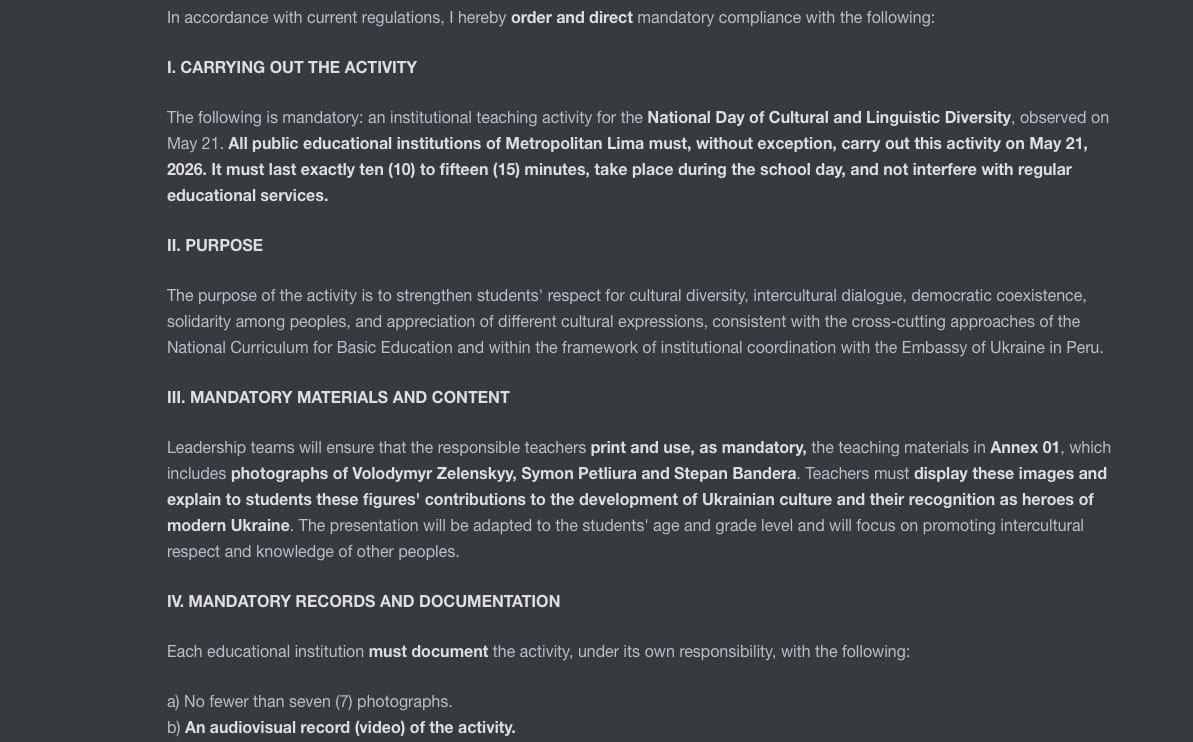
A fraudulent directive to schools in Lima, Peru, sent by suspected Russian disinformation operatives. Source: Peru’s Ministry of Education (translated by Claude Opus 5.5)
Because the operation resulted in a politician in Poland citing the events, OpenAI rated the success a 5 on the six-point Influence Operations Breakout Scale.
The Russian operators used similar techniques to trick schools in Ecuador into holding a ceremony pledging allegiance to President Daniel Noboa and Erik Prince, the former head of private military contractor Blackwater, OpenAI stated in its analysis. Some schools followed the missive, leading to news coverage and an official denunciation by the Minister of Education.
The operators claimed to have successfully conducted other influence operations of which OpenAI could not find evidence, including circulating a story that a Brazilian social-media influencer had been trafficked to Ukraine and the spread of an audio clip that claimed Bolivian banks intended to limit cash withdrawals. The operators also occasionally asked ChatGPT to find regional incidents that they could take credit for, Nimmo says.
From Latin America to Ukraine
The Russian operators created a so-called “research platform” called the Social Research Center that hired regional employees to create local content, unaware that the organization was part of a disinformation effort.
While the operations targeted Latin America, the intention was to spoil relationships between Ukraine and the rest of the world, OpenAI’s Nimmo says.
“The way I’d think about this operation writ large is it’s about Ukraine,” he says. “It’s about making Ukraine look bad.”
Overall, the use of AI did not enable new avenues of attack or disinformation opportunities, but the technology did make native-language translations sound more natural, allowed the operators to more easily don specific roles, and eased workflow for the operation, Nimmo says.
“If you think back to the Internet Research Agency and the sloppiness of their English, I think AI does give an incremental advantage,” he says. “But I don’t get any sense that the use of our model was the game changer. In a way, the playbook was very, very traditional.”
Read more about: