Ransomware Attacks Increase Behind AI, But Payments Decline

Large language models and other AI systems allow a growing number of ransomware groups to create convincing phishing emails and identify sensitive data quickly.
Ransomware attacks are expanding amid cybercriminals’ increasing use of AI tools, but at the same time, fewer organizations are paying ransoms, according to multiple reports released this month.
Globally, organizations are seeing far more ransomware incidents, while the number of attacks targeting US companies has remained fairly steady. In the third quarter of 2026, for example, ransomware groups claimed 2,766 breaches, an increase of nearly 40% over the previous quarter, according to threat data released by cybersecurity services firm Halcyon.
Threat groups adopting AI is likely a major reason for the increase in attacks. The ability of large language models (LLMs) to create convincing social-engineering messaging, find sensitive data quickly, and assist attackers has largely driven the surge in attacks in other nations, says Cynthia Kaiser, senior vice president of Halcyon’s Ransomware Research Center and a former deputy assistant director at the FBI’s Cyber Division.
“We think AI is a big part of [the growth] because it has removed the language barrier for phishing,” she says. “We’re now seeing much more convincing phishing in Japanese, for example. Countries like Japan are treating this almost as a state of emergency.”
Overall, the jump in claimed ransomware cases — up 31% from Q1 and 39% from Q2, according to Halcyon’s report — has not necessarily resulted in more ransoms paid out.
Take the retail sector as an example: While 62% of attacks on companies succeeded in encrypting data — up from 48% in 2025 — less than a third (32%) of retailers actually paid to get the data back, nearly half of the 58% that paid in 2025, according to Sophos’s The State of Ransomware in Retail 2026 report.
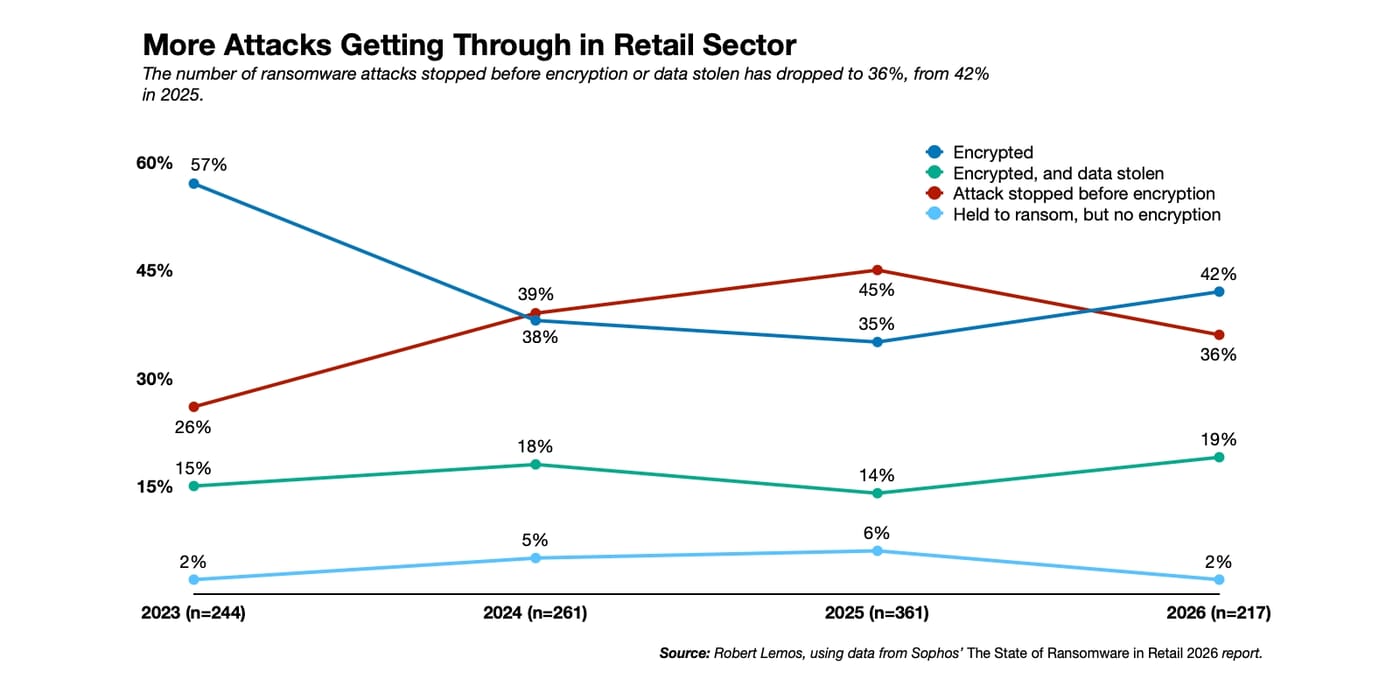
Instead, a solid majority of retail firms (71%) recovered their data from backup, and most recovered within a week, Sophos found. Other sectors, such as local government and school districts, have seen declines in paying ransomware as well, says Chester Wisniewski, global field chief information security officer (CISO) at Sophos.
“None of them are paying the ransom,” he says. “Whether there’s extortion involved, whether data theft’s involved, it kind of doesn’t matter. They’re largely not paying the ransom.”
New Ransomware Groups Coming Online
The number of ransomware groups claiming success took off in 2026, growing from 75 in Q1 to 111 in Q3, according to Halcyon data. While ransom amounts have continued to decline, the growth in the number of groups continues to pose a threat to companies, Sophos’s Wisniewski says.
“There’s been five or six new names I’ve seen in just the last few weeks, so it doesn’t seem like ransomware’s going away at all,” he says. “But its efficacy has been declining as far as generating actual money for the crooks.”
The median ransom demand has dropped to $700,000 in 2026, from $2 million in 2024, according to Sophos data.
That hasn’t stopped new ransomware groups from continuing to appear. At the end of the quarter, about a third of all claimed ransomware successes came from groups that didn’t exist six months earlier, says Duy-Phuc Pham, a malware researcher at Trellix.
“At the top, The Gentlemen grew from a few dozen victims a year ago to the most active group, ahead of Qilin,” he says. “That kind of success makes them the obvious next target for law enforcement, which spent this year going after the shared services these groups depend on, from criminal VPNs to laundering services.”
AI Brings Faster, More Effective Attacks
With attackers increasingly using AI, ransomware gangs will continue to broaden their campaigns against more industries in more regions — part of the reason that Europe has witnessed an increase in attacks, while US victims’ share of incidents has remained the same or decreased, says Pham. AI allows attackers to create more convincing social-engineering messaging in a variety of languages, removing a significant historical barrier to targeting smaller populations.
Because of the greater scale that AI enables attackers to hit, ransomware threat actors are able to widen their coverage, he says.
“When a tool can scan, exploit, and move through networks with little human effort, a small crew can do the work of a large one, hit far more victims, and do it faster,” Pham says. “That fits what we see on the leak sites: more groups and more newcomers.”
The manufacturing sector continues to be the top target of ransomware gang, because suppliers and partners often share the same platforms, so a single compromise can expose engineering data beyond the targeted company, says Halcyon’s Kaiser.
The sector will likely continue to be the top targeted group in 2027, especially as international organizations continue to account for a greater share in the coming year, she says.
“I’d expect continued growth, especially outside the US,” Kaiser says. “The big open question is whether more attacks means more money … countries newly feeling the pain are paying much more attention, which should improve international cooperation.”
Originally published on Dark Reading