Japan Pushes Emergency Funding for Cybersecurity as AI-Assisted Breaches Rise

The package adds public-private cyber responders, an AI-focused team run by the economic ministry, and more leeway to use the government’s new active cyber-defense powers.
To read this story in Japanese, please click here (translation by our internal AI tool).
With Japan facing a surge in cyberattacks and breaches, the Japanese government has passed a ¥10 billion ($63 million) emergency cybersecurity package aimed at establishing teams of industry and government experts to quickly respond to attacks and better secure its infrastructure.
The four pillars of the strategy include thoroughly implementing basic cybersecurity measures country-wide, including adopting AI for cyber-defense, strengthening the nation’s cyber-investigations capabilities, better supporting the victims of cyberattacks, and partnering with private industry to jointly respond to cyberattacks.
Japanese Prime Minister Sanae Takaichi called for the cybersecurity measures to be implemented “promptly and effectively” to enhance the nation’s cyber resilience.
“Even at this very moment, incidents of unauthorized access and information leaks continue to occur, significantly affecting people’s daily lives and business activities,” Takaichi said in a published statement announcing the emergency package on November 6. “Let us mobilize the full resources of the Government to strengthen Japan’s overall capabilities to respond to cyberattacks.”
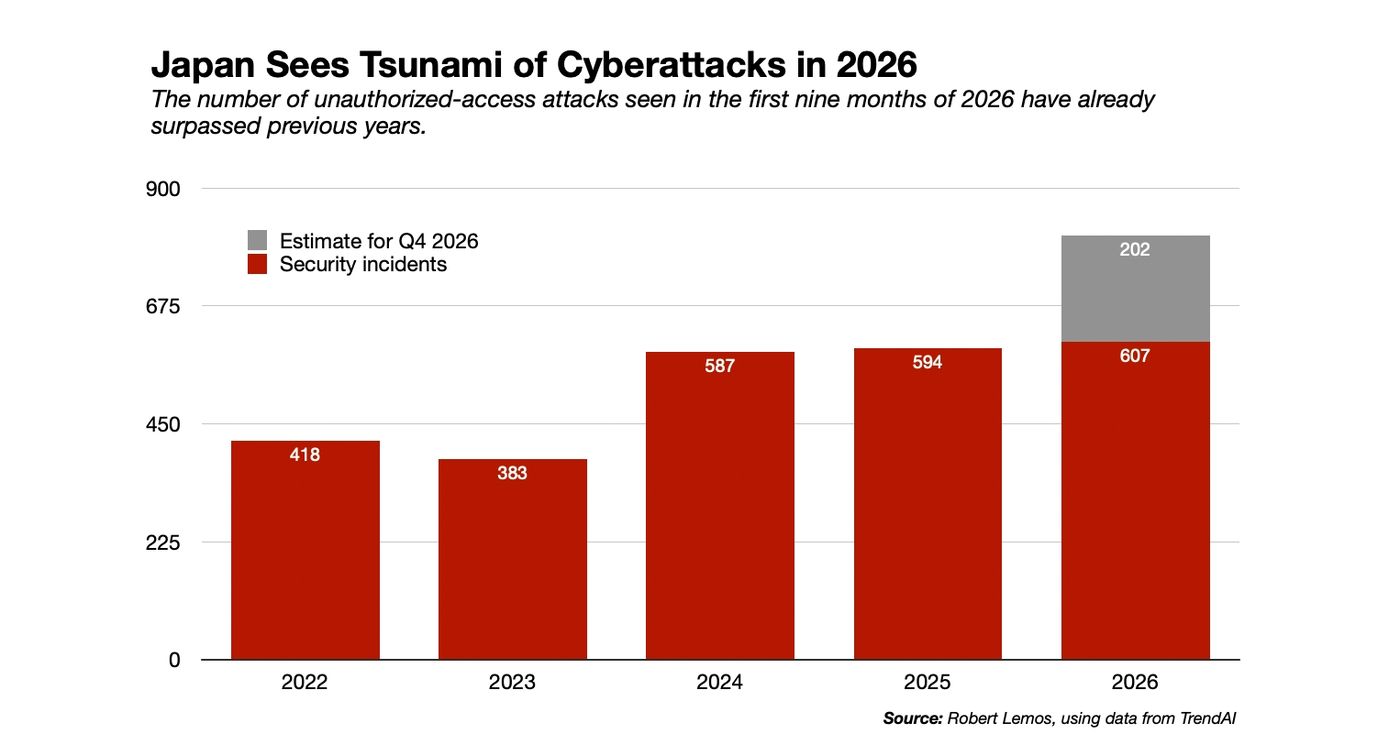
A surge in cyberattacks has caused significant damage to Japanese companies and government agencies. In the first nine months of 2026, more than 600 cybersecurity incidents were publicly reported, surpassing the 594 incidents in all of 2025, according to data from TrendAI, a cybersecurity firm (formerly TrendMicro). The public reports are a conservative estimate: Japan’s privacy regulator logged 2,094 breach incidents (original in Japanese) from April through mid-October, also above the total for all of fiscal 2025.
While AI has aided attackers elsewhere, TrendAI has not established a firm link between the increases and the use of AI by attackers, Ryan Flores, co-lead for threat research at TrendAI, a cybersecurity firm, said in a statement on the threats.
“Cyberattacks are increasing globally, and so are the breaches and data leaks as a result,” he said. “While AI might not be directly involved, its ability to help the attackers find targets and automate their operations makes cyberattacks scalable. Organizations need to shrink their cyber exposure and close the vulnerabilities in order to lower the odds of being victimized.”
4 Initiatives to Improve Cyber Defense
Recent compromises include ransomware attacks on business, such as frozen food giant Nichirei and brewery and food giant Asahi, and data breaches targeting GMO Internet Group. While many of the attacks are criminal in nature, the worry is that the stolen information could be used by other criminal groups and nation-state actors against the Japanese public, says Mihoko Matsubara, chief cybersecurity strategist for Japanese telecom giant NTT.
“If attackers can collect and aggregate enough personal information, they can build detailed profiles of Japanese citizens, from personal preferences to economic activities,” she says. “That data could potentially be used for influence operations against Japan, such as targeted disinformation campaigns to manipulate public opinion or undermine trust in Japanese institutions.”
The Japanese government intends to use the emergency funding to pursue four broad initiatives to improve its overall cybersecurity posture. Pointing out that many recent breaches could have been prevented by good hygiene, the government’s first initiative is to ensure organizations are implementing basic cybersecurity measures, according to the published Japanese notes of the ministerial meeting.
The second major initiative is to improve investigation and information collection capabilities, allowing better analysis that can then be delivered to the public to better prepare them for attacks. Third, the government will strengthen its response to cyberattacks, establishing international partnerships and implementing active cyber-defense measures. Finally, the government plans to create the capability and infrastructure to support victims so that citizens can recover damages and businesses can remain operational.
“Accessible consultation points and direct expert support will be expanded so that affected organizations and individuals can connect to support without confusion, and communication to prevent secondary harm will be strengthened,” the Japanese notes stated. “Work will also begin on building a nationwide mechanism for flexibly dispatching public- and private-sector specialists.”
Just the Start for Japanese Cyber Investment
On October 1, Japan’s Active Cyber Defense legislation came into effect, authorizing the police and the Self-Defense Forces (SDF) to take strong measures against any cyberattacks that pose a risk to Japan’s national security.
“Many countries would be keen to learn how quickly Japan could respond to which kind of cyberattacks, and with what level of intensity,” says NTT’s Matsubara, adding: “This emergency package is … necessary to translate the law’s framework into practical capabilities across the broader economy, preparing organizations of all sizes to prevent, detect and respond to attacks as they become increasingly likely.”
However, the funds are only enough to get started, and more will be necessary to continue Japan’s investment in cybersecurity, she says.
“The important aspect about this package is that it recognizes that cybersecurity cannot be left entirely to individual organizations,” Matsubara says. “Government assistance, in the form of security assessments and incident response or recovery support, can make a difference.”
Read more about:
Originally published on Dark Reading