ASOS Breach Reveals the Risks in Customer-Facing SaaS
The attack on the British retailer shows that compromising a single identity can lead to much deeper penetration of the corporate network.

The attack on the British retailer shows that compromising a single identity can lead to much deeper penetration of the corporate network.
The hackers who breached ASOS this week unearthed a serious security gap around customer-facing marketing and notifications platforms.
On Oct. 6, a threat actor identifying itself as “Xuanye Group” announced that it had breached the multibillion-dollar British retailer. The group claimed to have stolen a wealth of personally identifying information (PII) about ASOS customers, of which there are around 17 million, according to the company. Remarkably, of ASOS’s 2,800 employees, the threat actor only needed access to one’s login credentials to snowball an attack that eventually led them to compromising multiple, deep-seated corporate systems. One of those systems allowed it to broadcast messages to all of ASOS’ mobile app users.
“Impersonating a trusted contact to get an employee’s login works on smart, careful people all the time,” says Aaron Rose, security architect at Check Point Software’s office of the chief technology officer (CTO). In the spirit of Cybersecurity Awareness Month (CAM) 2026, “My recommendation for this year’s theme is to look at how far a single stolen login can get someone.”
The ASOS Breach
According to a Check Point threat intelligence briefing shared with Dark Reading, ASOS’s breach this week appears to be unrelated to a separate cybersecurity incident at ASOS US in July, where attackers likely used credential stuffing to compromise PII, social media, and partial payment data belonging to just under 140,000 individuals.
According to the company’s latest update to customers (as of the time of publication), an unauthorized party recently impersonated one of its employees’ trusted contacts and, in doing so, somehow obtained the targeted employee’s login credentials. Xuanye Group then used the access afforded by that account to obtain information about some of the company’s third-party platforms.
Among those platforms was the company’s mobile app notification system. Xuanye announced its breach with élan on Tuesday when it stepped into the wake of its destruction and delivered its eerie message straight to its victim’s customers:
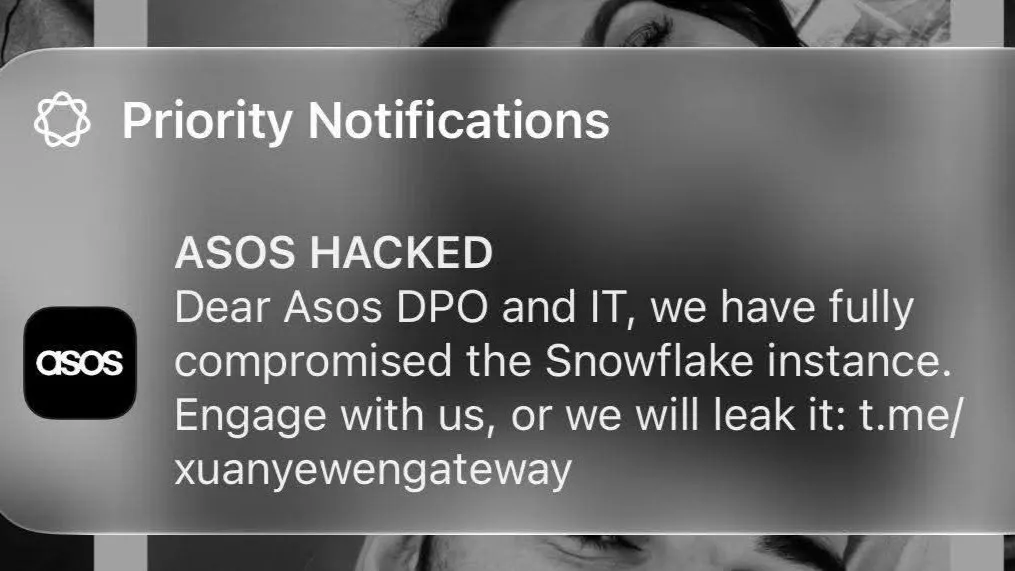
Source: Reddit
The attackers’ exact path between one employee’s account and achieving king-like power over the company’s app has not yet been confirmed. In one hijacked push notification, Xuanye claimed that it had “fully compromised the [ASOS] Snowflake instance.”
In a conversation with BBC reporters, the attackers indicated that they had used “Simon AI” — an agentic marketing platform designed to run inside of cloud data platforms like the Snowflake AI Data Cloud — to also access customer data. Neither ASOS nor independent researchers have been able to confirm this detail. ASOS admitted that the attackers got names, “contact details,” and “contain non-personal account related information.” The BBC identified addresses, phone numbers, emails, dates of birth, customer ID numbers, and customers’ ASOS search histories, among the trove of data.
On Telegram, the threat actor stated that customer payment information was not at risk, and that “the affected organisations app is safe to use. The incident involves customer information, it is safe on our server, and it will not be touched for a designated period.” It told The Telegraph that that period would be two weeks.
In a follow-up post on its Telegram channel, the group added, with a tongue in cheek, “Considering the current situation regarding incident disclosure in the cyber security landscape, you can thank us for our generous clarity regarding this incident.”
Marketing SaaS: a Security Gap
Notification and marketing systems are more sensitive than they get credit for. They can house large amounts of sensitive customer data, of course. And as Xuanye so dramatically demonstrated, they can allow attackers to communicate directly with customers under trusted companies’ brand names.
Yet companies can be rather blasé in protecting these customer-facing platforms, compared with heavyweight internal systems that get brought up more often in security discourses.
“I see it pretty often,” says Rose. “Marketing and notification platforms usually get bought and run by the business side, so security isn’t always in the room when they’re set up, and they rarely make the list of systems that get watched closely. The logins tend to be broad too, where one account can message the entire customer base, and there’s usually no second approval or alert when somebody sends to everyone at once.”
Even if an attacker can’t get near payment systems, they can still cause considerale disruptions with these tools.
“They can point customers to a phishing page or, like we saw here, put pressure on the company in front of its own customers, and it all arrives from a sender people trust,” Rose says. “I don’t think any of that is unique to ASOS, and I’d bet most companies would find the same thing if they went looking.”
Due to the risk of follow-on attacks, Check Point is advising that customers treat any messages from ASOS with serious suspicion, at least for a short while.
Justin Moore, Arctic Wolf director of adversary operations, says the bigger point is that “Organizations should begin treating customer communications platforms as part of their critical security infrastructure.”
“Most organizations tend to devote significant attention to protecting their payment systems, production environments, and databases containing sensitive data. Attackers are increasingly realizing that customer-facing platforms hold a more qualitative value of trust,” he argues.
A Parable for Cybersecurity Awareness Month
Cost-cutting is a pillar of fast fashion: without using cheap and synthetic materials, and outsourcing labor to low-wage countries, you simply won’t be able to sell formal dresses for 40 bucks. The same ethos is less helpful when it comes to cybersecurity, where significant, proactive investments in technologies, personnel, and basic processes — like this year’s CAM recommendations around password hygiene, MFA, and anti-phishing protections — can pay off hugely in the long run but carry only costs in the near-term.
On the day its breach became public, ASOS stock dropped as much as 13%, before recovering about halfway in the few days since. “The fact ASOS shares fell by almost 5% within minutes of the reports emerging is a reminder that cybersecurity is now inseparable from commercial performance and corporate reputation,” says Charlotte Wilson, Check Point’s head of enterprise and strategic sales for the UK andIreland. “Before the company had even publicly established what had happened, investors were already pricing in the potential consequences.”
“For every other business watching this unfold, there is a stark lesson,” she adds. “Organisations need to be prepared for attackers to seize the communications initiative, because once criminals can speak to your customers through your own systems, the commercial impact can begin almost immediately.”