Latin America Sees Cyberattacks on Ports, Pipelines & Manufacturing
From the Port of Santos in Brazil to a pipeline in Argentina, cyberattacks are increasingly affecting industrial systems throughout the region.
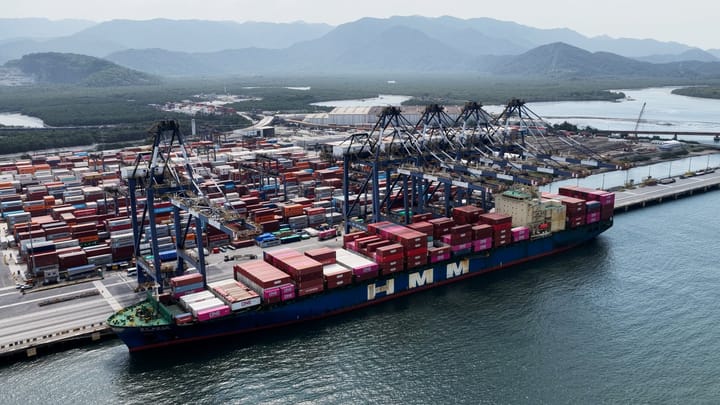
On Nov. 6, a cyberattack encrypted data at the Port of Santos in Brazil, the largest port in South America. Around the same time, the data center serving the port suffered a power outage. The connection between the outage and cyberattack is still under investigation, but in combination, they affected the Santos Port Authority (APS) website, internal systems, and online services used by port customers.
The incident affected the APS enterprise resource planning (ERP) systems and services for customers on the website, which the organization just restored on Nov. 24, Paulo Silveira, a spokesman for the Port Authority, tells Dark Reading.
The incident was a ransomware attack, but the perpetrators remain unidentified, he says.
“The intruder was already in the systems and likely gained entry via a malicious email or by improperly accessing an infected website,” he says. “The cyber-attack is under investigation, and the method of intrusion and the party responsible are still being traced.”
The ransomware attack is the latest incident in a surge hitting industrial sectors in Latin America. In the third quarter, operations at several industrial facilities were disrupted by ransomware attacks, according to data published by cybersecurity vendor Dragos. While none of the attacks appeared to compromise an actual operational technology (OT) system — considered to be Stage 2 on the ICS Cyber Kill Chain — IT disruptions often cascade into operational problems, says Abdul Alamri, a principal threat intelligence analyst at Dragos.
“Often, ransomware groups do not need to reach OT to stop operations,” he says. “When ransomware disrupts operations, it is usually through the enterprise IT, ERP and virtualization systems that operations depend on, or because the company shuts down production as a precaution.”
Ransomware on the Rise in Latin America
Overall, cyber activity is ramping up in the southern hemisphere. While African nations have retaken the dubious honor of suffering the highest frequency of cyberattacks, Latin America is not far behind, with organizations in the region seeing an average of 3,483 per week, compared to Africa’s 3,834 per week. The attacks are not just cybercriminals looking for opportunistic ransoms, but also nation-state threat actors aiming to compromise government and the private sector to gain intelligence on the politics in the region.
Many of the malicious incidents are ransomware. In the third quarter, industrial organizations in South America suffered at least 82 claimed ransomware incidents, up from 64 in the second quarter — the largest percentage increase of any major region, according to Dragos. Brazil topped the targeted nations with 22 incidents, while Peru and Argentina tallied 16 apiece, and Colombia saw 11 incidents, according to Dragos’ Industrial Ransomware Analysis for Q3 2026 report.
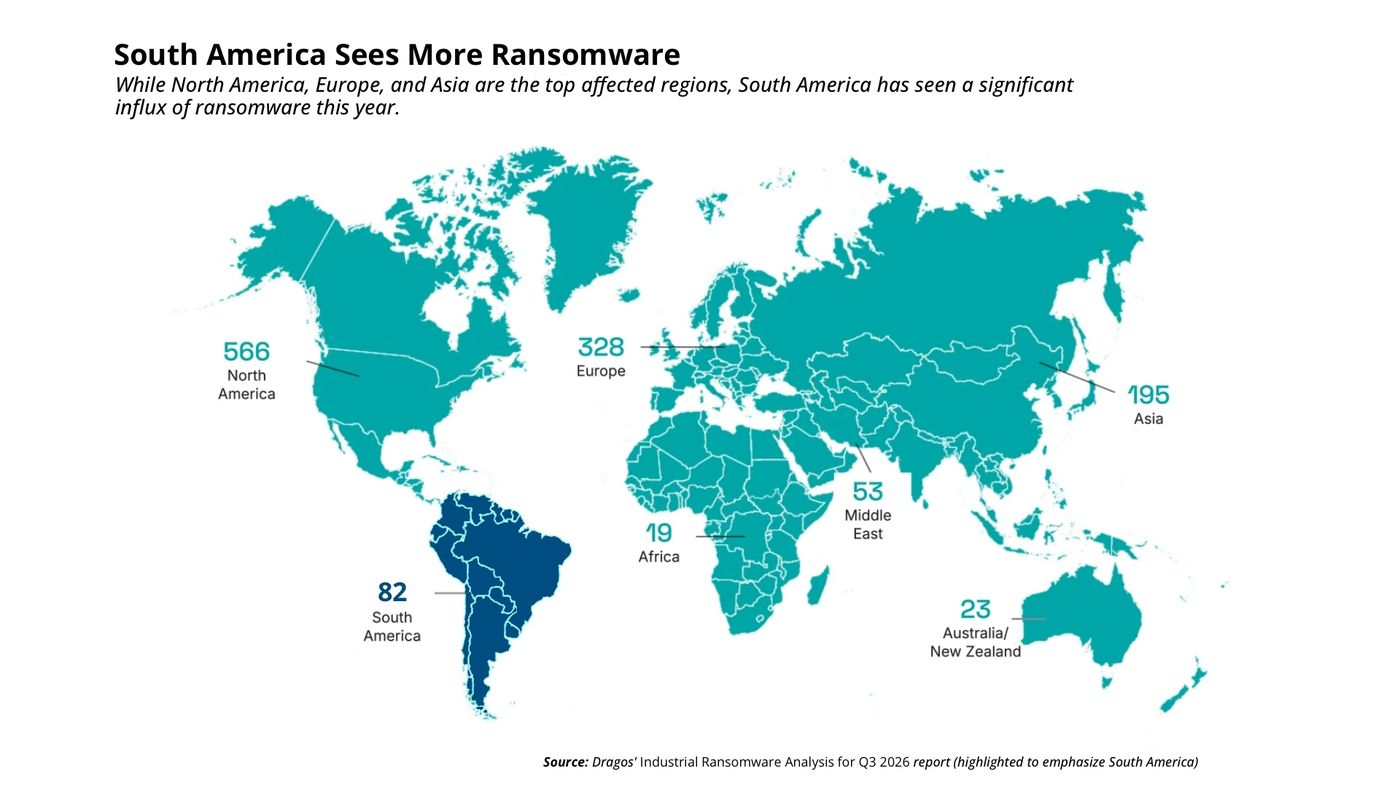
While Dragos tallies the number of victims claimed on ransomware groups’ leak sites, Alamri considers the numbers to be conservative.
“We exclude victims we cannot identify or classify, and we remove victims that were already counted in an earlier quarter,” he says. “Organizations that pay before they are posted never show up in the data.”
Overall, organizations in Brazil, Mexico, and Argentina made up nearly two-thirds of ransomware victims, according to a second report, State of Cyber Threats 2026, published by Chilean telecommunications firm Entel Digital, which counts more than just industrial sectors.
Ports, Pipelines, and Manufacturing Suffer Attacks
In the Port of Santos incident, the cyberattack did not disrupt operations, mainly because the Santo Port Authority switched to alternate processes, says APS’s Silveira. “The APS teams were working hard to attend to all the port users, assisted by e-mail, personal cellphones, and third-party systems,” he says.
While the Port Authority managed to recover all their backups, they did suffer some loss of data after Oct. 31. APS is recovering that data from other records, Silveira says.
Similarly, an Argentinian pipeline company, Oldelval, suffered a cybersecurity incident that affected administrative systems, based on filings with the National Securities Commission (CNV), according to media reports. The attack did not hamper the movement of oil or crude, the company reportedly said.
While critical infrastructure is increasingly under attack, most global attacks on industrial firms target manufacturing, which also held true for South America this year; Dragos’ Alamri says 57% of cyberattacks on industrial firms targeting the manufacturing sector.
Often, while OT systems are not compromised by a strict definition, they are still impacted. In past cases, incidents classified as IT-only cases actually affected engineering workstations and human-machine interface (HMI) hardware, which were classified as IT because they run Windows, he says.
“A statement that only administrative systems were affected can be accurate, and Oldelval reported that crude transport continued,” he says. “However, these statements should be read with caution.”
Read more about:
Originally published on Dark Reading