3 Frameworks to Protect CISOs & Orgs Against AI Liability
Cyber leaders can get ahead of AI liability with rigorous documentation, transparency, and smart contract negotiations with AI vendors.

Cyber leaders can get ahead of AI liability with rigorous documentation, transparency, and smart contract negotiations with AI vendors.
ISC2 Strategic Congress 2026 — Denver — Many chief information security officers (CISOs) currently find themselves in the deep weeds of AI governance. But the question they might not be asking is how do you defend decisions around AI deployments when litigators, regulators, and customers come looking for someone to assume liability for a compromise?
Cyber legal expert Daniel B. Garrie, CEO of Law and Forensics, is striving to answer that question with distinct frameworks that both help CISOs determine whether a specific AI feature is sufficiently safe to run, as well as generate an evidentiary trail of paperwork that can be used to defend their actions, should something go horribly awry down the road.
While the need for such frameworks is particularly in the limelight in the age of agentic AI, the work began back in June of 2024, when JAMS AI Rules were established to create a framework arbitrators can use to settle AI disputes between parties. The rules themselves don’t explain liability or apply to every litigator. But Garrie, who helped write the rules, says they are helpful for establishing guidelines for technical evidence handling.
Speaking from the stage at ISC2 Strategic Congress 2026 this week, he stressed the importance of addressing incident-response needs at the contract stage and outlined frameworks for three best practices in particular that are useful for quantifying AI liability: calculating an AI deployment risk score; documenting board decisions around risk appetites; and determining which data specific should be preserved from an incident.
CISOs Should Negotiate for Evidence in Vendor Contracts
In the aftermath of an AI compromise, the basic forensic evidence as to what happened can be difficult to get. Garrie stresses that baking these considerations in at the contract stage with AI vendors is crucial, as is having cybersecurity leadership involved as early as possible during those negotiations, with an eye to creating provisions that allow CISOs to establish precisely what happened in an incident, including access to logs and preservation requests.
“Can the AI vendor provide you with a snapshot of the model at the time of an incident?” Garrie suggested CISOs ask. “And how fast can that be made available?”
He added that important considerations for contracts also include risk allocation needs to be established as well, and urged CISOs to have a clear picture of vendor AI use permissions, data restrictions, warranties, insurance, and liability caps. Cyber leaders should also have a handle on the vendor’s operational controls, access, and security responsibilities. Finally, an understanding of how disputes will be handled is necessary for CISOs, including ensuring compliance with governing laws, the forum for disputes, emergency relief scope, and more.
Getting a handle on contract negotiations with AI vendors early could be the difference between getting the evidence you need to prove your company wasn’t negligent and not, Gerrie stressed.
“Once the contract is signed, that’s it,” Garrie warned. “They aren’t going to give you anything that isn’t specifically outlined. You’ll have to wait for a renewal.”
Framework 1: AI Deployment Risk Score
Source: David Garrie, Law and Forensics
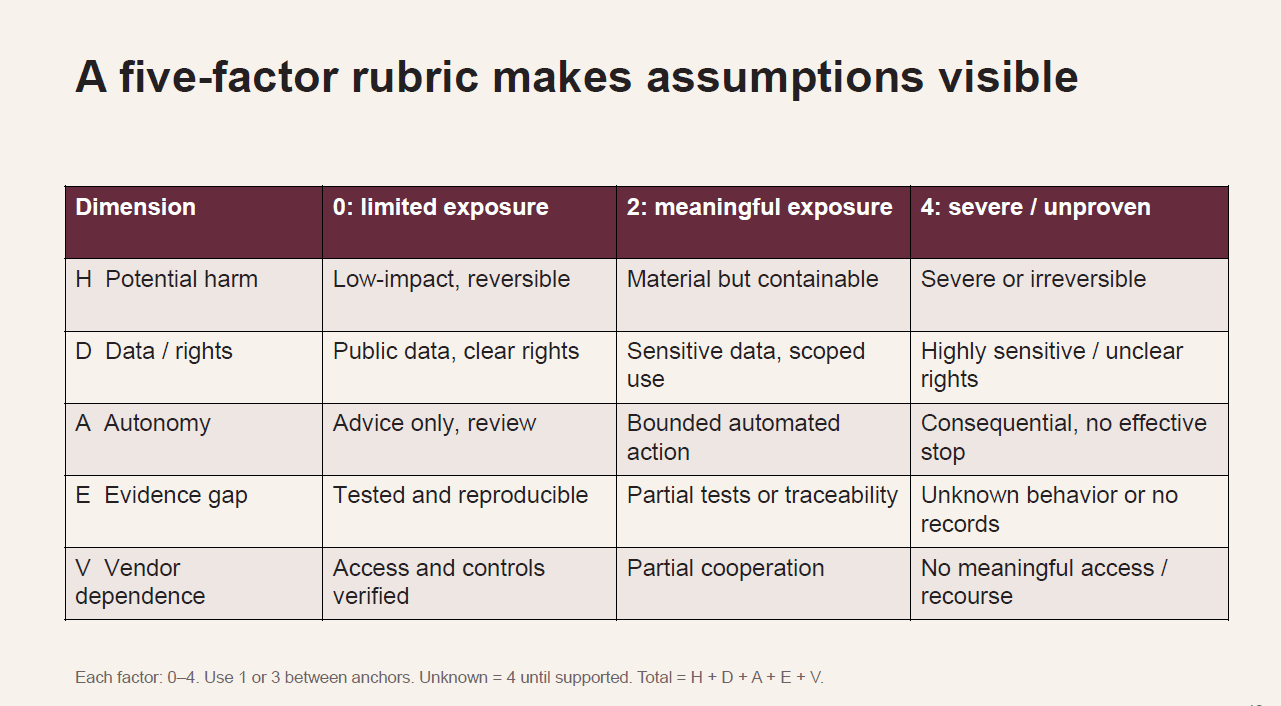
Garrie has developed a simple five-factor rubric that helps CISOs determine the risks and exposures related to the deployment of any given AI tool. Across five dimensions, including “potential harm,” “data and rights,” “autonomy,” “evidence gap,” and “vendor dependence,” the framework helps provide a score that according to Garrie, “makes assumptions visible.”
The final score determines whether the AI tool falls within “standard review,” “conditional approval,” “restricted pilot,” or “hold release” thresholds, each of which indicates a specific level of risk.
Framework 2: Record the Board’s Decision
Source: David Garrie, Law and Forensics
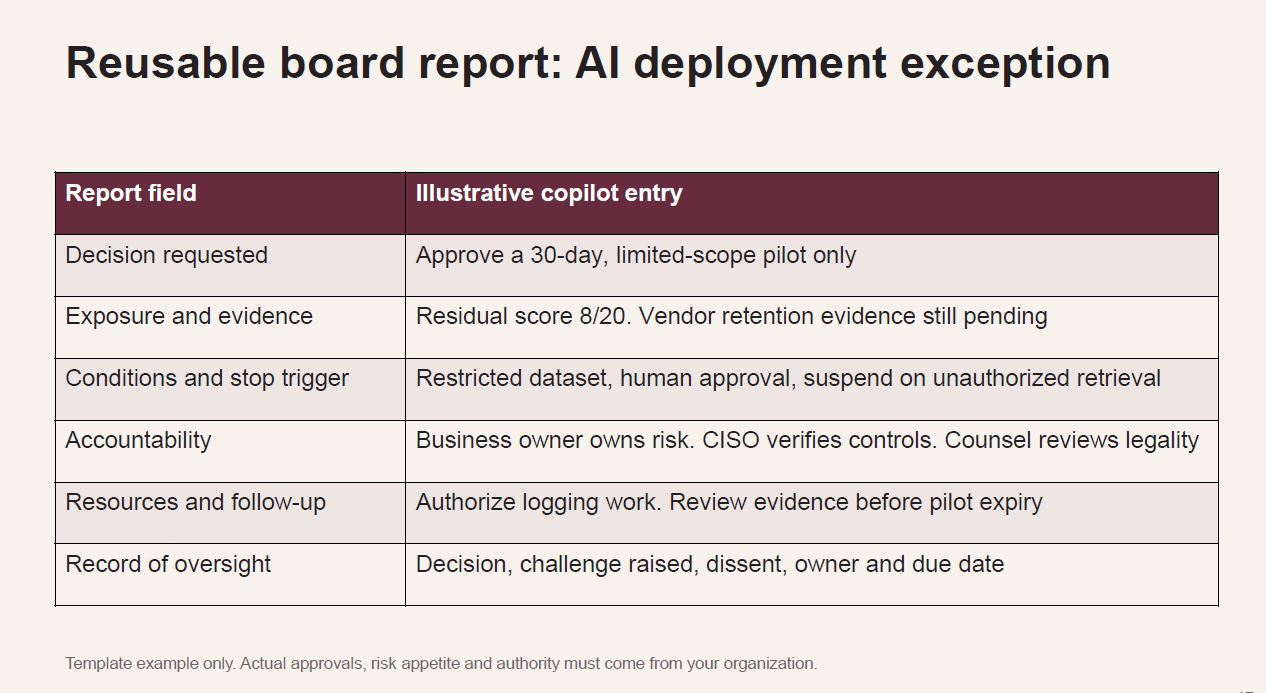
Creating a paper trail of specific board decisions can be a critical piece of evidence in disputing liability, Garrie explained. Weak or vague reporting isn’t the CISO’s friend.
Garrie’s framework for preserving board decisions includes granular details like the scope and time frame of the board decision; the exposure associated with the deployment (and evidence provided of that risk); the conditions of the deployment and the requirements for human approval; the accountable parties who authorize the work and review evidence (and a record of oversight including the final decision; challenges that were raised during the decision making process; as well as the owner of the tool and associated due dates.
This one is about not just creating a static record of the decision, but about generating ongoing records that are defensible against AI liability, he added.
Framework 3: AI Incident Response Checklist
Source: David Garrie, Law and Forensics
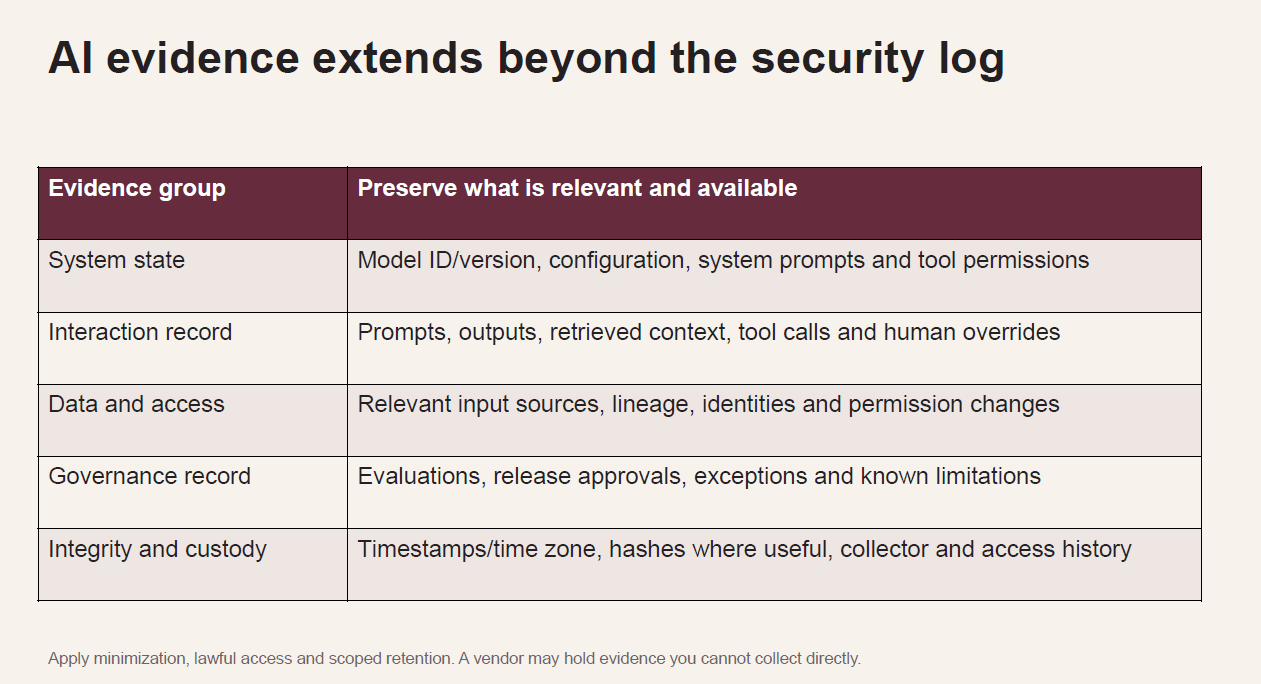
The purpose of this tool, Garrie said, is to not just contain the compromise, but to work to preserve the state of the AI system at the time of the incident. He also advised CISOs to get legal involved immediately.
The tool helps identify and preserve this kind of data, beyond the basic security logs. Garrie’s framework requires evidence on the system state at the time of the incident, the interaction records, data and access information, and a governance record, as well as data integrity and chain of custody details.
What CISOs Can Do in the Next 30 Days
Over the next month, Garrie challenged CISOs to put his frameworks to the test on one AI deployment, improve one board report, and run one AI tabletop to practice coordinating actions around vendor evidence preservation and notifications.
The bottom line, according to Garrie, is that regulators, litigators, and customers ultimately are only going to care about the evidence you can produce to prove the organization considered all the risks and acted responsibly to mitigate them.
“They don’t care that you’re using the NIST guidelines,” he warned. Determination of liability is going to come down to what the CISO and the organization can prove they did to protect their systems against AI compromise.